
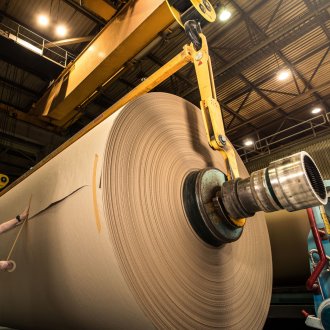
 Since January 1, 2024, seven paper mills out of a total of 81 have permanently ceased operations in France with a significant consequences for employment.
April 22, 2026 - At its annual press conference, COPACEL, the French Union of cardboard, paper and pulp industries, brought to light the increasing number of paper mill closures in France over the past 24 months, as well as the fragile situation of several sites at the beginning of 2026 — developments that underscore the urgent need for an ambitious policy to support reindustrialization.
Since January 1, 2024, seven paper mills out of a total of 81 have permanently ceased operations in France. These industrial site closures have significant consequences for employment, wealth creation, regional development, and industrial sovereignty (France is structurally a net importer of pulp, paper, and cardboard).
Furthermore, two packaging paper companies are under court-ordered restructuring, while a group operating two large-capacity pulp mills is engaged in conciliation proceedings. Beyond these specific cases, several other companies exhibit vulnerabilities that could worsen due to the combined effects of falling selling prices, insufficient equipment utilization, and rising production costs.
Christian Ribeyrolle, President of COPACEL, stated, "The paper industry provides our fellow citizens with products that are both traditional and innovative, contributing to the fight against climate change and the development of the circular economy. Faced with the growing risks to the sustainability of many sites, it is urgent to implement an ambitious industrial policy that serves the competitiveness of our industry and the sovereignty of our country."
While some closures were unavoidable, particularly in the graphic paper sector (newspapers, magazines), paper products remain essential to the 21st century economy. The renewable nature of the raw material, wood, and the high recycling rate of paper and cardboard (87%) place them at the intersection of the bioeconomy and the circular economy. Thanks to significant R&D efforts within the industry, paper and cardboard are acquiring new functionalities, enabling them to increasingly replace plastic packaging. Thus, the closures of paper mills in France are less attributable to a decline in demand than to the difficulties faced by French companies in withstanding increasingly intense international competition.
Several factors explain this deindustrialization. Firstly, in certain market segments, overcapacity among foreign producers encourages the importation of products (particularly from China), sometimes at prices lower than production costs in France. This pressure is amplified, for certain paper categories, by American tariffs, which redirect volumes initially destined for the United States to the European market. Secondly, France is still struggling to improve the competitiveness of its heavy industries (due to the burden of production taxes, energy costs, and administrative complexity), resulting in production costs higher than those of competing countries.
COPACEL calls for the rapid implementation of measures, both at community and national level, because the discourse of public authorities on reindustrialization must be followed by concrete effects:
COPACEL (French Union of Cardboard, Paper and Pulp Industries) is the professional association for the paper industry. COPACEL brings together 74 companies, employing nearly 10,000 people.
SOURCE: COPACEL