
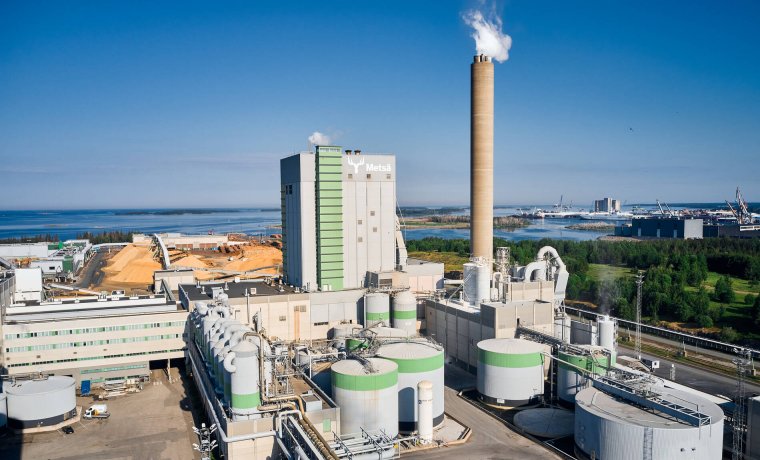
 The carbon capture plant would be located at Metsä Group's Rauma pulp mill in Southwestern Finland (pictured above), and its nominal capacity would be about 100,000 tonnes of captured wood-based carbon dioxide per year.
March 31, 2026 - Metsä Group has started a pre-engineering project for the first commercial biogenic, i.e. wood-based, carbon capture plant. As part of the plant's financing plan, the company has submitted an application for a reverse auction organised by Finland's Ministry of Economic Affairs and Employment which distributes investment aid for clean transition projects.
The carbon capture plant would be located at Metsä Group's Rauma pulp mill in Southwestern Finland, and its nominal capacity would be approximately 100,000 tonnes of captured wood-based carbon dioxide per year. Carbon dioxide would be captured from the mill's flue gases.
According to Metsä Group, the planned capacity of this commercial production plant would be the first step towards a larger scale --- the long-term capture potential of wood-based carbon dioxide at Metsä Group is several million tonnes per year. Carbon dioxide can be used, for example, as a raw material in the chemical and fuel industries, thus replacing fossil-based raw materials and products.
"Metsä Group has been working on the utilisation of wood-based carbon dioxide for a few years," said Niklas von Weymarn, CEO of Metsä Group's innovation company Metsä Spring. "We're exploring this possibility primarily from the perspective that carbon dioxide can serve as a raw material for new products. We're therefore very pleased that the first supply agreements with customers have now been signed.
"The emergence of completely new value chains and markets often requires public financing in the early stages. The reverse auction funding is a one-off investment grant that can accelerate the commercialisation of the technology and create significant new industrial activities in Finland," von Weymarn added.
The application for an environmental permit for the plant was submitted in December 2025, and the official permit decision is expected later this year.
Annual use of 100,000 tonnes of wood-based carbon dioxide in the fuel value chain could avoid fossil emissions comparable to the annual emissions of nearly 30,000 passenger cars," the company pointed out.
Ismo Nousiainen, Metsä Fibre's CEO, noted, "The capture of wood-based carbon dioxide would support Metsä Group's strategy of strengthening the fossil-free business and developing competitive new products. At the same time, it would improve the competitiveness of our pulp production."
In 2025, Metsä Group piloted technology to capture carbon dioxide from the flue gases of the Rauma pulp mill in collaboration with the technology group Andritz. The pilot showed that the technology was sufficiently mature for controlled upscaling.
The project's main uncertainty is related to market developments, as industrial value chains that utilise wood-based carbon dioxide are still being built. The emergence of new markets requires simultaneous investment decisions from multiple operators. This potential investment by Metsä Group could help accelerate the development of an entirely new value chain.
Metsä Group has its roots in the Finnish forest: its parent company Metsäliitto Cooperative is owned by approximately 90,000 forest owners. The Group focuses on pulp, paperboards, tissue and greaseproof papers, wood products, and wood supply and forest services. In 2025, Metsä Group's sales totaled EUR 5.8 billion and about 8,800 employees.
SOURCE: Metsä Group