
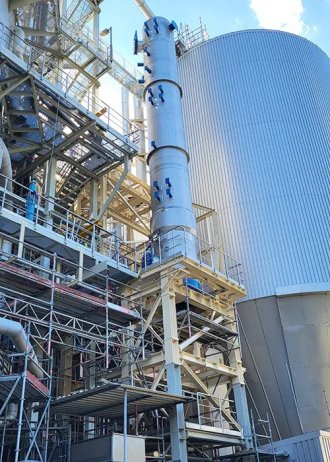
 Now that the new evaporator is operating, the Rosenthal mill is tracking four practical outcomes: energy use, on-site electricity, water intake, and water-treatment needs.
PaperAge editor's note: the following article was originally published by Mercer International.
Feb. 16, 2026 - Commissioned in early November 2025, a targeted efficiency upgrade at Mercer Rosenthal is expected to reduce steam demand in the cooking process, free capacity for additional electricity generation through existing equipment, and lower fresh water withdrawal through improved condensate recovery.
The Rosenthal pulp mill, located in Rosenthal am Rennsteig, Germany, has the capacity to produce approximately 360,000 tonnes per year of softwood kraft (NBSK) pulp. In addition, the facility yields about 5,000 tonnes of tall oil and over 400,000 MWh of green electricity annually — self-generated energy that not only powers the mill but also provides electricity to about 50,000 households.
In a modern mill, the biggest efficiency gains often come from reducing "hidden losses," such as steam that does less work than it should, clean condensate that cannot be recovered, and heat that is not fully reused across the system. Mercer Rosenthal's new cooking liquor evaporator (CLE) upgrade, supplied by Valmet, is designed to reduce those losses in one of the mill's most energy-intensive areas: cooking.
"Efficiency is not a slogan in a mill. It is a daily discipline," said Dr. Christian Sörgel, Managing Director for Mercer Rosenthal. "When you reduce avoidable steam demand and recover hot condensate back into the system, you strengthen the steam-and-power balance and reduce the need for fresh inputs."
Steam and water are core operating inputs in pulp production. Improvements in the cooking area can affect the wider site by lowering energy demand, improving flexibility in the steam network, and reducing the amount of make-up water and treatment required. For readers outside pulp, think of it as tightening a heat-and-water loop so the site uses less energy and brings in less new water to do the same work.
In practical terms, the upgrade is expected to support:
In pulp production, wood chips are cooked in a pressurized vessel called a digester. Traditionally, medium-pressure steam supplies a significant portion of the heat required for that cooking process.
With the upgrade, a partial stream of the hottest black liquor (the spent cooking liquid that is recovered and reused) from the digester is routed through a pre-evaporator. Medium-pressure steam supplies heat for this step, and the vapor produced is returned to the digester-replacing part of the direct steam otherwise consumed by the digester.
Two system effects drive the broader efficiency improvement:
Now that the upgrade is operating, the mill is tracking four practical outcomes — energy use, on-site electricity, water intake, and water-treatment needs — comparing performance before and after start-up under similar production conditions. The figures below reflect project documentation and are being validated against site baselines.
Why it matters: steam is a major energy input. Using less steam means lower energy demand and more flexibility in how the mill uses heat.
Why it matters: if more steam is available to run through the turbine, the mill can generate more of its own electricity using existing equipment.
Why it matters: recovering and reusing more hot water inside the process reduces the amount of new water the mill needs to bring in.
Why it matters: when the mill needs less make-up water, it typically needs less chemical treatment to protect equipment and maintain water quality.
Note: Figures are expressed on a per-hour basis in project documentation. Mercer Rosenthal is confirming baseline periods, operating conditions, and whether the power figure represents realized output or enabled capacity as tracking continues.
This is the kind of improvement Mercer pursues across its operations: reduce waste, recover more value from existing systems, and strengthen performance without relying on major footprint expansion. It reflects the same efficiency mindset Mercer applies across the supply chain — from fibre procurement through manufacturing and logistics. Over time, projects like this compound and support cost discipline, stronger resource efficiency, and more value from existing assets.
Mercer International is a global forest products company with operations in Germany, the USA, and Canada. Its consolidated annual production capacity is 2.1 million tonnes of pulp (air-dried tonnes, ADTMs), 960 million board feet of lumber, 210 thousand cubic meters of CLT, 45 thousand cubic meters of glulam, 17 million pallets, and 230,000 metric tonnes of biofuels.
SOURCE: Mercer International Inc.