
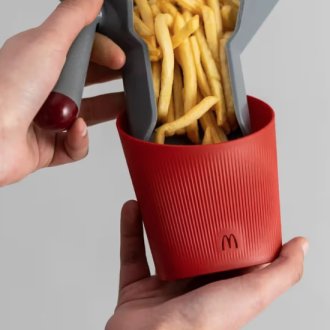
 McDonald's research suggests plastic items need to be reused 100+ times to make them preferable environmentally to single-use products. Jon Banner, McDonald's global chief impact officer, pointed out in a separate interview, "We're not getting anywhere near that in the real-life experience."
Dec. 8, 2025 - McDonald's has released a comprehensive report, "The Complex Reality of Reusable Packaging in Europe", which questions the environmental benefits that the European Union says will be achieved through the implementation of its new Packaging and Packaging Waste Regulation.
In a nutshell, the EU's new law aims to: make all packaging on the EU market recyclable in an economically viable way by 2030; safely increase the use of recycled plastics in packaging; and decrease the use of virgin materials in packaging and put the sector on track to climate neutrality by 2050.
McDonald's October 2025 report provides analysis using "real-life" data from McDonald's supply chain and restaurants in Europe, comparing reusable plastic packaging versus single-use fiber and plastic packaging.
The following are excerpts from The Complex Reality of Reusable Packaging in Europe, which presents insights into the potential environmental, operational and financial impacts of introducing reusable packaging in McDonald's restaurants:
At McDonald's, we use a wide range of guest packaging and believe that hygiene, food safety, quality, functionality and sustainability are critical aspects to packaging design. We strive to accelerate solutions that reduce packaging waste, transition to more sustainable packaging materials, move away from virgin fossil fuel-based plastics and promote circularity. As of year-end 2024, 90.93% of our global primary guest packaging3 (95.2% in Europe) was sourced from renewable, recycled or certified materials.
3 Primary guest packaging: Single-use fiber and plastic packaging used to package guest food and drinks on premises at McDonald's restaurants that is given to customers in all order channels.
Recognizing that reducing the use of plastic and substituting plastic with certified or recycled paper are two of the key interventions to address plastic pollution, we are removing or reducing plastic use by redesigning packaging items. For example, we have partnered with our suppliers to advance technologies to replace plastic lids and sundae ice cream cups with innovative fiber solutions. Most of McDonald's primary guest packaging is fiber-based (82% globally and 96% in Europe as of year-end 2024), meaning it is primarily made from materials such as paper, pulp, cardboard or wood.
In addition to designing our packaging for recyclability, we are working to help advance the recycling of guest packaging globally. In 2024, 89.6% of restaurants in markets with advanced infrastructure offered guests the opportunity to recycle and/or compost packaging items, with customer-facing bins for back-of-house or off-site sorting. We are also working with external partners to establish and improve recycling.
We believe there is not one solution to advancing circularity; it requires fact-based dialogue and evidence among stakeholders — including leveraging business expertise. Solutions need to consider implications at each stage of the value chain, be tailored to sector and local conditions, be rooted in customer safety and hygiene, and balance economic, environmental and consumer outcomes.
Reusable packaging is packaging for food and beverages that customers can use and then return to a business, such as a restaurant, where it is washed and then reused for another customer. Reusable packaging is viewed by some policymakers as a solution to reduce packaging and plastic waste, which has led to regulatory requirements that limit the use of single-use packaging materials or mandate reusable packaging. These regulations apply to the foodservice industry, encompassing businesses that prepare and serve food and beverages outside of the home, including restaurants, cafés, hotels and catering services.
For reusables to reach the breakeven8 point or have comparable or lower environmental impacts compared to single-use packaging, an optimal number of uses must be achieved. The number of uses achieved is impacted by items that are not returned by customers, as well as items that may be returned but not reused due to damage.
8 The breakeven point is calculated by adjusting the number of reuses in each scenario until the environmental impact is equal to the Single-use scenario.
For takeout, the average number of reuses observed is very low, due to a low number of customers returning the reusables. For dine-in, where reusable packaging items are not intended to leave the restaurant, a higher number of reuses has been observed relative to takeout.
Overall, the analysis highlights that introducing reusable packaging in McDonald's restaurants does not achieve an overall positive impact compared to single-use packaging across the impact areas measured and the scenarios modeled.
The analysis shows an overall negative environmental impact of reusable packaging compared to single-use packaging when implemented against the EU PPWR requirements in 2030, which impact over 6,900 McDonald's restaurants in the EU. Across the scenarios, there are varying results dependent on the environmental indicator, which means there are environmental trade-offs.
The results highlight that when reusables are offered for dine-in and takeout in McDonald's restaurants, plastic waste from guest packaging increases. This is due to the shift from McDonald's fiber-based single-use packaging to reusable packaging made entirely from plastic.
The analysis finds that when reusables are offered for dine-in or takeout, plastic waste increases and fiber waste decreases (compared to using fiber-based single-use packaging). The change in plastic waste and fiber waste volumes is dependent on the number of customers using reusables and the average number of reuses achieved. In the 2030 scenario, when 10% of menu items sold for takeout are in reusable packaging, plastic packaging waste increases more than six times (626% per restaurant per year), while fiber waste reduces by 12%.
The analysis indicates that GHG emissions associated with guest packaging (linked to production, transport, energy use for washing reusables and end-of-life) typically increase where reusables are offered for takeout and dine-in (compared to fiber-based single-use packaging). Under Scenario 2030, with 10% of menu items served in reusables for takeout, GHG emissions increase by 61% per restaurant per year.
The analysis shows that, per item, GHG emissions associated with packaging production are higher for reusable plastic items compared to fiber-based single-use items, and the process of washing the reusable items also generates emissions, which means a sufficiently high number of reuses needs to be achieved to offset the emissions from production and washing.
The analysis also shows that the scale of impact can vary, dependent on which single-use packaging items are replaced with reusables. In Scenario A, if paper wraps (used for sandwiches and burgers) were replaced with reusable containers, GHG emissions would increase by 30% per restaurant per year.
Scenario A (France): Reusable packaging is mandatory for dine-in only. Fiber wraps are permitted for all sandwiches and burgers. The observed average number of uses for reusable packaging items is 33.9.
The assumed recycling rates used in the analysis also influence the impact on GHG emissions. The Single-use scenario has an assumed and cautious recycling rate for fiber-based packaging of 46% for dine-in and 3% for takeout. However, a higher recycling rate would reduce the GHG emissions associated with single-use fiber-based packaging (such as the 92% fiber recycling rate for dine-in packaging in McDonald's Germany).
If the fiber recycling rate modeled increased to 80% for dine-in and 30% for takeout, this would lead to an 11% reduction in GHG emissions for dine-in and an 8% reduction for takeout (per restaurant per year) in the Single-use scenario. This underpins the importance of further advancing recycling infrastructure and collection processes available in Europe.
The complete report, The Complex Reality of Reusable Packaging in Europe, is available here
SOURCE: McDonald's